Past Exhibitions
Oblique Views: Archaeology, Photography, and Time
October 25, 2015 through May 7, 2017
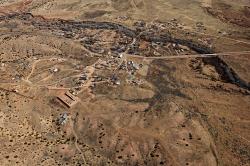
Galisteo
Galisteo is now considered statistically part of the Santa Fe metropolitan area, although it is still remote and has a population of less than three hundred people. It is home to a number of well-known artists and scholars, as well as families traditionally linked to the area, none of whom farm on the scale of the past. Galisteo Creek no longer washes away vegetation in the streambed, which now appears to be a lush forested strip. The church and cemeteries remain, as does the layout of the colonial village. Traces of the old narrow fields can still be seen. Photograph by Adriel Heisey, 2015.
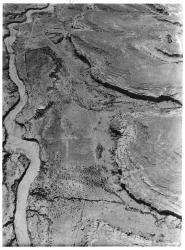
Pueblo del Arroyo, Pueblo Bonito, and Chetro Ketl
This higher-elevation photograph shows three great houses—Pueblo del Arroyo, Pueblo Bonito, and Chetro Ketl—in addition to what appears to be irrigated areas. The geographic proximity of these three great houses is clear. These and Pueblo Alto, on the upper bench to the right of Pueblo Bonito and not visible in this photograph, create what some have called Downtown Chaco. Historic use of the canyon can be seen in structures near Pueblo del Arroyo and Pueblo Bonito: buildings, a corral, and roads. Additionally, active excavation was taking place at Chetro Ketl when the photo was taken. Rather than being far from the bustle of the world, those living at Chaco Canyon in the summer of 1929 must have found themselves in a lively social setting. Photograph by Charles A. and Anne Morrow Lindbergh, 1929.
For the first time in Oblique Views: Archaeology, Photography, and Time, large prints of Heisey’s stunning images will be paired directly with the Lindberghs’. The exhibition opens October 25, 2015 and runs through May 7, 2017 at the Museum of Indian Arts and Culture.
During 2007 and 2008, flying at alarmingly low altitudes and slow speeds, Adriel Heisey leaned out the door of his light plane, and holding his camera with both hands, re-photographed some of the Southwest’s most significant archaeological sites that Charles Lindbergh and his new bride Anne photographed in 1929.
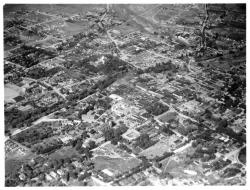
Santa Fe
Even in 1929, Santa Fe was an art center, the state capital, and a historic community. It was still a town rather than a city, however, and agricultural fields can be seen not far from the Plaza (approximately at the center of the photo), the heart of the social and economic life of the town. The old capitol building can be seen surrounded by trees in the upper center. Trees also mark the Santa Fe River, which forms a wandering diagonal from lower left to upper right. North is to the right in this photograph. Photograph by Charles A. and Anne Morrow Lindbergh, 1929.